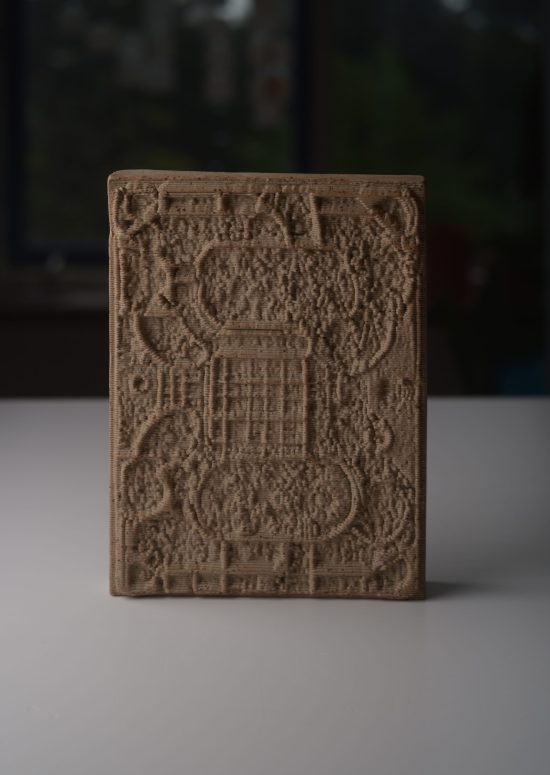
This project investigates the existing role and position of 3D physical and digital modeling in ceramics with special emphasis on their mutual dependency, complementarity, and conditioning by employing musical rhythms.
In the music compositions, precision lies in the subdivision of beats. Practicing and the skill are crucial for interpreting rhythmic notations accurately. This precise beat subdivision resonates within the domain of parametric drawing. Similar to how a musically literate individual navigates beats. By intertwining machine language’s numeric essence with music’s inherent mathematical nature, I explore their intersection.
Much akin to musical rhythms emerge from the fluid interplay and transition of tones, a parallel interplay unfolds within the realm of a 3D printer. Governed by an algorithm In this method, parameters and rules determine the relationship between points and lines intent and the response and the nozzle performs shifting and sliding movements, resulting in a body of work. By analyzing La Folia , I’ve employed its rhythmic values to develop 3D printing algorithms and fed them into parametric program.

 Parametric drawing involves transforming features through algorithmic processes—and it also allow me using G codes to prevent potential issues arising from rendering on slicing programs those might lead to patching or smoothing. These algorithms transformed ceramic surfaces into canvases, rendering visible the exchange of data between human and machine.
As I contemplate on a sonata or an orchestral experience, I’m triggered by its resonance with societal dynamics, where individual contributions seamlessly merge into a unified whole. My work process looks into themes such as dedication, inspiration, timing, communication, respect, innate abilities and impact of loss. I deliberately selected La folia for its improvisatory freedom within its musical structure. It’s oscillating theme and the harmonic pull speaks to the human condition, offering insights. Music is timeless, reached across generations and cultures. However i find it important to note, our perception of music is inherently linked to the period in which we live, influenced by our social, political, and cultural experiences.
Using musical notes to interact with parametric programs has been a rewarding process, opening opportunities to explore surface qualities. I use the term “surface qualities” as it symbolizes the representation of time, notations, and the dialogue between instruments. These practices of communication and dedication are, to me, deeply fascinating subjects that speak to the human condition.
My research extends beyond ceramics, music, or digital technology, focusing on musical rhythms as systems of interplay, interdependence, and influence. I draw parallels between the collaboration of individual musicians and the fabric of broader communities. When I contemplate an orchestra, I am captivated by the perfect harmony that emerges when each musician contributes their unique talent, becoming part of a greater system—a song!
I embrace the edges between the physical and the digital world, which are increasingly intertwined. I wanted to start working and develop my own approaches to using 3D printing technologies, appreciating the deficits and discrepancies of our current capabilities as well. Questioning the overtrust in the precision and consistency of digital processes in our society, I want to experiment with the errors of the 3D printer that creates unforeseen, non-repeatable poetic results. Within these tests, I’m introducing new information; akin to musical disruption. This deliberate challenge aims to modify the original order and structure of note sequences, much like a violin or cello player introducing an extra note or incorporating a new bar within a 16-bar structure.
This research and development project was funded by CBK Rotterdam.
As part of this research, I collaborated with musician Burcu Ramazanoglu, Ania Katynska and engineers Peter Eigenraam, Idil Gumruk, Thomas Lindemann and architect Elmar van Cleynenbreugel.